Panelists highlight Indigenous history, community during Newhouse event
Have you had an experience with Syracuse University’s Title IX office? Share your story with The Daily Orange’s anonymous tip line.
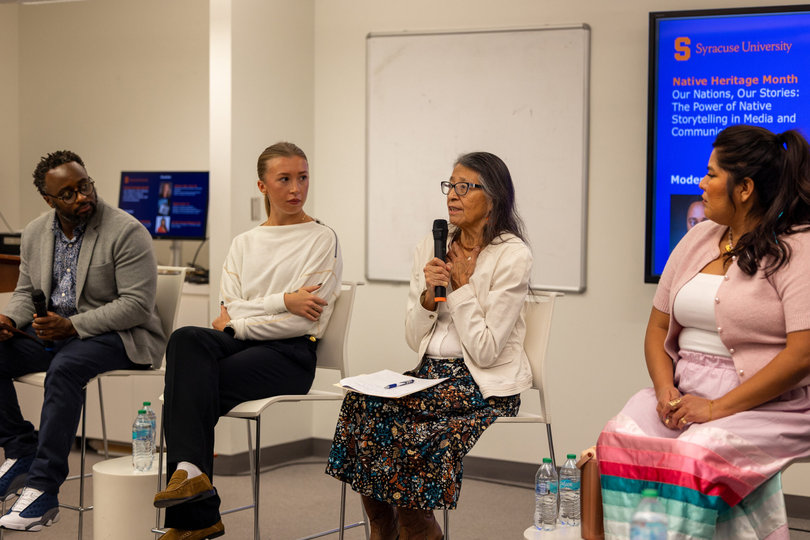
Panelists at Syracuse University’s Our Nations, Our Stories event discussed on Monday how to “indigenize” media by giving the stories of Native communities more coverage.
The Newhouse School of Public Communication’s Office of Community, Culture and Engagement hosted the panel in honor of Native Heritage Month. Wesley Whiteside, associate director of OCCE, moderated the Our Nations, Our Stories panel, beginning with a land acknowledgement.
“I acknowledge with respect the Onondaga Nation, firekeepers of the Haudenosaunee, the Indigenous people on whose ancestral lands Syracuse University now stands,” Whiteside said.
The land acknowledgement often precedes important speeches or events at SU, intended as a gesture of respect and acknowledgement of the Native community in the area, Whiteside said. The sentiment was echoed by the panelists.
While some believe the land acknowledgement is a “hollow gesture,” Regina Jones, a panelist, Witness to Injustice Coordinator and Elder in Residence at the Native Student Program, said she believes it’s important.
“That’s kind of a debate,” Jones said. “There was a lengthy version that was put forth by students, and it went through a lot of editing and changing. I think it’s respectful.”
Other panelists included Jourdan Bennett-Begaye, managing editor of ICT, and Allyson Trice, sales representative at Stryker and member of the Haudenosaunee Nationals Lacrosse Organization’s women’s team.
Whiteside stepped in for Tammy Bluewolf Kennedy, assistant director in admissions overseeing Partnerships Programs and Indigenous Recruitment at SU, who couldn’t make the event due to travel complications.
Jones, a member of the Oneida Nation Turtle Clan, began by emphasizing the importance of storytelling, especially through her Native culture.
“I think it’s important for people to understand the history of Indigenous people and the genocide and everything that we’ve overcome, but mostly we’re still here,” Jones said.
WHAT YOU SHOULD READ NEXT
Indigenous members discuss democracy’s impact on sovereignty in SU panel
Indigenous members discussed democracy’s impact on their sovereignties at SU’s “American and Indigenous Democracy” panel.
In her role at the Witness to Injustice program, organized by the Syracuse Peace Council and Neighbors of the Onondaga Nation, Jones invites students to learn about the colonization that Indigenous people have experienced through a three-hour interactive activity.
For Bennett-Begaye, a Diné citizen of the Navajo Nation, storytelling is always present in his life, just in different forms.
“You can gossip. You can do it visually. You can do data,” Bennett-Begaye said. “People have always been doing it since time immemorial.”
At ICT, a newspaper that prioritizes highlighting Indigenous stories and voices, Bennett-Begaye edits stories across Indigenous communities in North America. She talked about the struggle between balancing accuracy and cultural responsibility when reporting Native stories.
Bennett-Begaye used an example of ICT’s coverage during the COVID-19 pandemic, as the newsroom wanted to honor the deaths of tribe members while also conducting accurate reporting. Generally, using the word death is frowned upon in Indigenous culture, and before it was revised in 2018, writers would instead say “walked on.”
“We need to be a little more accurate and a little more tangible,” Bennett-Begaye said. “It has to be factual so everyone can know what happened.”
When asked what non-Native students or people from other communities can do to support Native voices, Trice emphasized the importance of being educated and asking questions.
Trice also highlighted the history of lacrosse, which originated in Indigenous communities. She’s a member of the Haudenosaunee Nationals Women’s National Lacrosse team, which placed fourth in the 2026 Women’s World Lacrosse Championships, behind the United States, Canada and Israel.
“I think it is really important, especially in the fight for us to be a part of the Olympics,” Trice said. “And I wish people would know that this community has to work way harder than the average person and jump through way more hoops.”
The Haudenosaunee women’s team is currently trying to prove their sovereign status to the Olympic Games.
Audience member and Newhouse Foundation Fellow Wesley Perez Vidal shared the importance of different cultures getting proper coverage in the news. He emphasized that covering Native people, the nations and the Firekeepers of Syracuse are extremely important, because the campus resides on their land.
“A newsroom should reflect the diversity of its audience because we are serving the audience,” Vidal said.
Toward the end of the panel, Jones reflected on whether or not she should be encouraging education, specifically at a predominantly white institution.
“But I do, because it’s an opportunity for our people to receive an education,” Jones said. “We have this unique population of Haudenosaunee students on campus.”