Historian, SU Ph.D. alum’s book recounts Onondaga Nation through resilience
Get the latest Syracuse news delivered right to your inbox.
Subscribe to our newsletter here.
UPDATE: This story was updated at 1:45 a.m. EST on Nov. 18, 2026.
Author and historian Michael Oberg, 62, recalled the United States’ preparation for the Columbus Quincentenary as he pursued a doctorate in history at Syracuse University in the early 1990s.
The event, meant to commemorate the 500th anniversary of Christopher Columbus’ arrival in the Caribbean, garnered backlash and rejection by Indigenous peoples and allies. This changed Columbus’ legacy and the scholarly approach to Indigenous history “forever,” Oberg said.
“There’s a lot of historians who realized that they can do their work better by talking with Indigenous people,” Oberg said.
The attention drawn by Native communities during the Quincentenary’s backlash caused Oberg to begin demonstrating the importance of accurate historical storytelling through his work, he said.
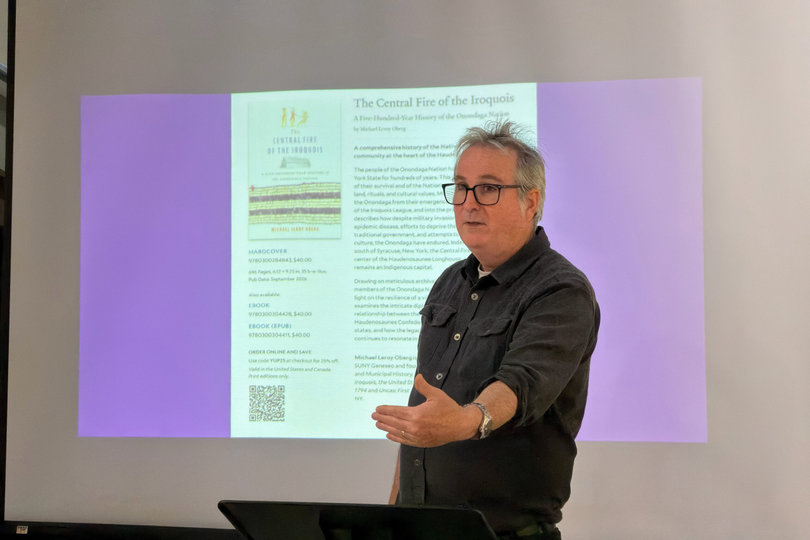
The Skä•noñh – Great Law of Peace Center, located in Liverpool along the Onondaga Lake, hosted Oberg on Saturday for a public discussion on his latest book, “The Central Fire of the Iroquois: A Five-Hundred-Year History of the Onondaga Nation,” published Sept. 29. Oberg’s book, researched and written over 15 years, recounts the Onondaga Nation’s enduring place within the Haudenosaunee Confederacy.
After earning a Ph.D. in history in 1994 from SU’s Maxwell School of Citizenship and Public Affairs, Oberg began his academic teaching career at Montana State University Billings, where he stayed for four years before moving to Rochester, New York, to teach as a distinguished professor of history at SUNY Geneseo.
His book, “The Central Fire of the Iroquois” details the history and resilience of the Onondaga Nation, despite centuries of systematic dispossession and interference, Oberg said. It closely follows the Onondaga people through warfare, disease, attempted eradication and the deprivation of their land, culture and tradition.
“Despite everything, Onondaga has endured,” Oberg said.
The eventual global honoring of Indigenous Peoples Day was catalyzed by Native communities’ rejection of the Columbus Quincentenary. “Quincentenary” is a term used to describe a 500-year milestone, though it’s associated with the 1992 anniversary of Columbus’ 1492 voyage. The Quincentenary’s rejection spurred a larger Indigenous movement that’s since driven measurable institutional strides toward acknowledging the realities of Indigenous history, Oberg said.
Oberg’s interest in Indigenous history began in college when he took a Native American literature class at California State University, Long Beach. Oberg earned his bachelor’s degree in 1987 and his master’s in 1989. During his studies at SU, Oberg centered his dissertation on tensions between Algonquian peoples and early English settlers.
Oberg’s work shifted toward Haudenosaunee history in 1998 when he became a professor at SUNY Geneseo. Oberg was approached by the Tonawanda Seneca Nation to work on the Grand Island land claim. Since then, he’s helped different Haundenosaunee nations by researching land rights, gaming, taxation and environmental issues.
Oberg was inspired to write his book during his legal work with the Onondaga Nation. Oberg was hired by the Onondaga Nation in 2011 to conduct research on the cultural history of Onondaga Lake. Onondaga Lake, which is adjacent to the city of Syracuse, no longer sits within Onondaga reservation boundaries after the 1788 Treaty of Fort Schuyler and later land concessions to New York state that significantly downsized the territory’s land base, Oberg said.
Onondaga Lake is considered one of the most polluted lakes in the country and a designated contaminated zone. Under the “Superfund Act,” a law that authorizes the cleaning of hazardous waste zones, federally recognized Indigenous nations have a legal right to input on cleanup planning, including at off-reservation sites where sacred land or natural resource impact can be established.
Oberg helped the Onondaga Nation substantiate their sacred connection to the lake through research. He was tasked with compiling a 900-page annotated bibliography, documenting their relationship with the water, which later became research for his book.
“Much of Onondaga history is wrapped around water,” Oberg said. “And trying to protect or resurrect waters that had been damaged by forces totally beyond their control.”
Traditional Onondaga history says Onondaga Lake’s shore is the founding site of the Haudenosaunee Confederacy, where peace was made among the warring nations through an agreement made between Onondaga leaders Tadodaho and Hiawatha, and the Peacemaker, a spiritual messenger.
This agreement was bound by the Great Law of Peace, a democratic system of governance that would ultimately inspire the creation of the U.S. Constitution.
“Here they are,” Oberg said. “The Onondaga remain the central fire of the Haundenosaunee. That seemed to me a story I wanted to tell.”
Oberg spent years examining archival records. He also spoke directly with Onondaga Nation community members, as the Haudenosaunee have transmitted their history and teachings through generations of oral storytelling.
Without those interviews, Oberg said “The Central Fire of the Iroquois” couldn’t have been written, as many members’ stories helped fill gaps left by Westernized history. Though Oberg began working on the Onondaga Lake cleanup in 2011, the historical biography wasn’t published until 15 years later in September.
Ronnie Francisco, interim director of the Skä•noñh – Great Law of Peace Center, hopes readers will recognize the book’s relevance to the political and physical climates in the U.S.
Francisco says non-Native readers should reflect on the ancient Haudenosaunee systems present in Oberg’s book, as they still prove functional today. She also suggested the readers “borrow more principles than they already have.”
Francisco referenced the Great Law of Peace, noting Haudenosaunee principles of matriarchal authority, environmental kinship and long-term sustainability that were omitted from the U.S. Constitution.
“People don’t really understand the reach and the influence of the Confederacy,” Executive Director of the Onondaga Historical Association Lisa Moore said. “And the power that was held.”
A portion of Oberg’s research for his book relied on access to collections within the Onondaga Historical Association’s archives, a space he frequented while working on past projects. Moore said reaching new audiences with Onondaga history and promoting the Skä•noñh Center is “thrilling,” as it’ll allow for a better understanding of the place and its people.
During Saturday’s book talk, Oberg delivered a presentation to 45 attendees about his research on the Onondaga Nation that led to “The Central Fire of the Iroquois.” He told individual stories that illustrated their resistance against forceful assimilation and the defense of sovereign rights and nationhood.
He also described the nation’s endurance as the book’s central theme and shared his struggle with the ending, considering the nation’s story is still ongoing. At a meeting on the territory, Oberg asked those around the table for advice on its conclusion. Their answer was “just tell them we’re still here.”
WHAT YOU SHOULD READ NEXT
Panelists highlight Indigenous history, community during Newhouse event
Panelists at SU’s Our Nations, Our Stories event discussed how to “indigenize” media by representing the stories of native communities.
Lisa Gibson, who attended Oberg’s book talk, has family roots in multiple Haudenosaunee nations, including Onondaga. Gibson said community division and intergenerational trauma prompted her to look deeper into her history. She heard of the book talk and felt it was important to attend and learn more.
“I’m on this journey of trying to find out who our people are and why we’re living the things that we’re living today,” Gibson said.
Gibson hopes non-Native readers “see the truth” in the pages of “The Central Fire of the Iroquois” and do their part in enacting change. The Haudenosaunee cannot heal if nations are being continuously oppressed, she said.
Oberg’s book argues the Onondaga Nation’s influence despite their relatively small numbers, and its place as a capital site in Indigenous America. He draws on principles of coexistence and autonomy demonstrated by the Two Row Wampum, a beaded belt symbolizing one of the oldest peace treaties between the Haudenosaunee and European settlers.
In today’s political polarization, while many Indigenous nations continue to face opposition from non-Native power structures, Oberg said it’s important to tell silenced stories.
“There’s always going to be that competition, that hostility,” Oberg said. “Settler-colonialism being alive and well. Still, you gotta fight them, and hopefully the book will help do that.”