
Guest Column: Brittany Broski’s past controversies warrant accountability
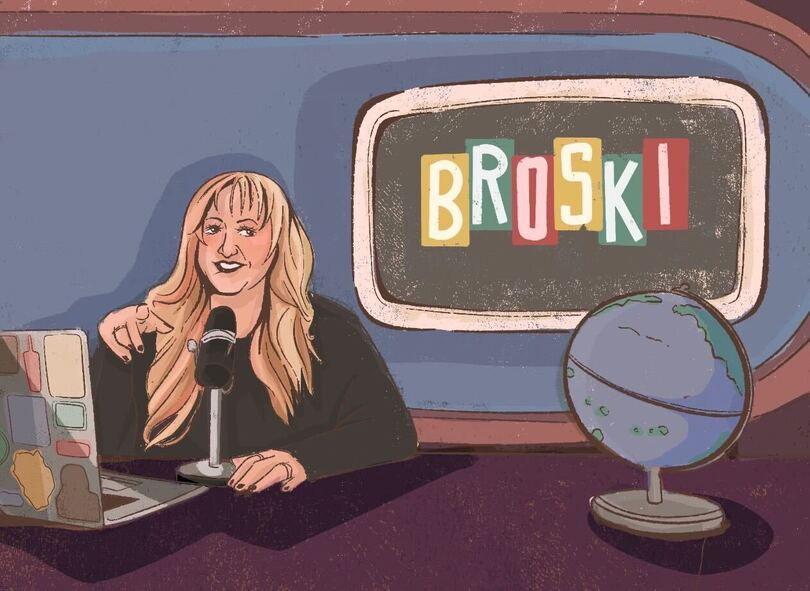
Our guest columnist argues University Union needs to consider inclusion when booking entertainment. When UU books performers like Brittany Broski with past controversies, it leads some on campus to feel dismissed, she argues. Emma Soto | Contributing Illustrator
Get the latest Syracuse news delivered right to your inbox.
Subscribe to our newsletter here.
On March 4, the campus organization University Union posted on Instagram that Brittany Broski would be speaking at Syracuse University on Wednesday. Broski has had several controversies surrounding and pertaining to people of color and women.
Incidents including when Cody Ko faced criticism for a relationship with Tana Mongeau involving an 8-year-age gap (17 and 25), fans looked to Broski as she had a strong relationship with Cody Ko.
Her response, stating, “If these allegations prove to be true,” sparked an uproar, as many of her followers felt she came across as incredibly dismissive. Broski did ultimately condemn the situation on her Instagram story, but her response was delayed and didn’t fully center empathy for Tana.
This incident doesn’t paint Broski in the best light, with greater tension arising from her use of African American Vernacular English. It’s no secret that “Twitter language” has become more widely adapted in social media. But, it can be exhausting to see white comedians gain fame through the use of Black dialect. The issue is deeper than word choice, encompassing the image she projects and how her humor is received. Broski is seen as funny, whereas similar speech is labeled “ghetto” and “trashy” in Black communities.
When called out about this in 2020, Broski dismissed the criticism, referring to it as “internet language” and turning a teachable moment into a missed opportunity to acknowledge the deeper issue at hand.
As a Black student on a primarily white campus, it’s already hard enough to navigate the misunderstandings, microagressions and shortcomings that come with being one of few in academic and social spaces. When faced with UU’s post, I felt no excitement — only the familiar feeling of being dismissed once again.
In a statement to The Daily Orange, UU wrote all artists and speakers brought to campus are reviewed in collaboration with the Student Engagement Office, which ensures that university policies and procedures are upheld, including speaker review.
“We are also aware that Brittany Broski has publicly addressed and condemned the Cody Ko allegations and has taken actions such as removing related content,” UU wrote. “We encourage students to consider the full context when forming opinions.”
UU positions itself as an organization that builds community, gives students exposure to new perspectives and creates shared student experiences. But, I question what kind of common experience this offers.
When speakers who have used racist or sexist language are invited to campus to speak without being held accountable or asked to acknowledge their past behavior, it sends a message. It tells marginalized students that their comfort and experiences don’t matter when it comes to campus entertainment.
This isn’t about one person or “influencer.” It’s about a broader pattern of behavior and perception. A campus that advertises diversity in its branding but fails to reflect it in high-impact programming has a responsibility to reconsider whose voices it amplifies.
Representation isn’t merely about filling a demographic quota. It’s about intent. It’s about recognizing how certain choices may harm students who already feel invisible.
This situation was particularly disheartening because when I made comments on the post expressing disapproval, they were quickly removed. Not just once, and not by mistake. In other words, instead of engaging in open and honest dialogue, the organization chose to shut it down.
The deletion of dissenting views was intentional, silencing marginalized students until they become critical further solidifies a damaging culture of discourse: Marginalized voices are welcome until they criticize; dialogue is welcome until it becomes uncomfortable.
Representation isn’t merely about filling a demographic quota. It’s about intent.Layla Riley, Guest Columnist
This behavior is exceptionally harmful, especially coming from one of the more largely known campus organizations. This is the team responsible for selecting representatives for the university. I believe that UU’s relatively little effort toward programs celebrating Black History Month is an indication of a lack of real interest in being inclusive. Even though UU has recently hosted one event, a single performative program won’t fill the gap created by a long-term history of inaction.
UU wrote in its statement that they didn’t remove comments expressing concerns about Brittany Broski or the event. The only comments that were removed were repetitive spam comments, specifically posts consisting of repeated “Boo” messages, GIFs and more spam completely unrelated to any controversy, UU wrote, which were “moderated in accordance with (their) standard social media practices to maintain a respectful and constructive environment.”
“We understand that students may have differing perspectives on public figures, and we respect those viewpoints,” UU wrote. “At the same time, our role is to provide opportunities for dialogue, entertainment and shared campus experiences.”
For students of color and other marginalized groups, campus life already requires constant negotiation. We must decide when to speak up, when to educate others about issues and how much energy to expend. When frustrations with the way things work are ignored by an organization that’s supposed to represent those concerns, it only adds to the exhaustion.
The issue is now bigger than that one incident. Inclusion is not a marketing strategy; inclusion is a practice. Who is included in the conversation, who is heard and who is protected reflect whether or not a community practices inclusion. If the organization wants to build back the trust lost by its actions, UU needs to listen.
Delete and deflect is not listening. Listening is what minority students want from all campus organizations — not to tell them how to run campus programs, but to be considered as part of them.
Layla Riley is a sophomore majoring in Information Management Studies & Political Science. She can be reached at llriley@syr.edu.