
How SU’s chefs, dining hall staff feed thousands every day
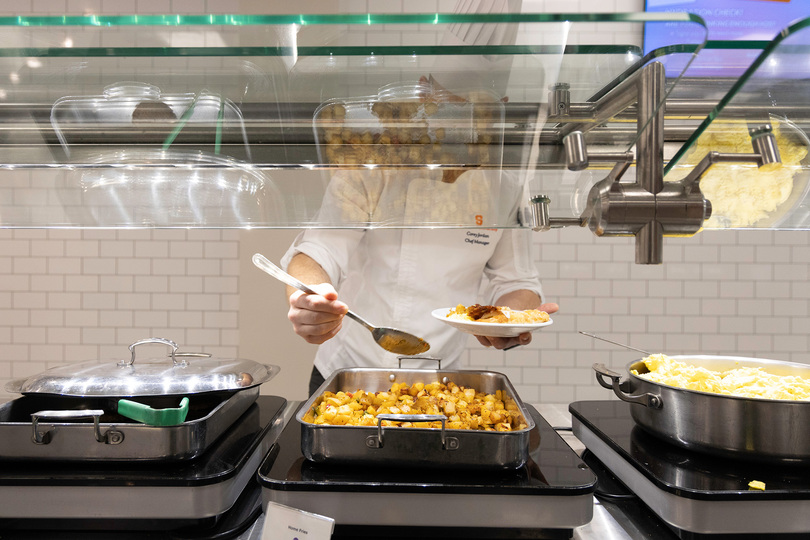
For chef managers at Syracuse University dining halls, they have to ensure menus are equipped with serving all food groups while not repeating meals throughout the semester. At athletic dining centers, chef managers must follow NCAA-mandated training table meals for student athletes. Solange Jain | Senior Staff Photographer, Claire Zhang | Asst. Digital Editor
Get the latest Syracuse news delivered right to your inbox.
Subscribe to our newsletter here.
Whether it’s in between classes, during a study break or before a football game, the more than 15,000 undergraduate students at Syracuse University have to eat somewhere. Their options range from picking up a Dome Dog at the JMA Wireless Dome to a salad from CoreLife Eatery at the Schine Student Center.
But with over 8,000 meal plan users, people like Richard Leonardo, SU’s corporate executive chef of Campus Dining, need to track what students are consuming and what’s being disposed.
“If you ever see me in a dining center, you will see me somewhere near the trash area because I want to see what’s being taken, but maybe not eaten,” Leonardo said.
When Leonardo arrives at his office every morning, he reviews roughly 20 photos of SU dining halls’ food waste from the day before. The photos help the dining halls control their consumer waste. Leonardo tracks consumption through Leanpath, AI software that measures how much food is thrown away each day.
Students eat roughly 12,000 meals a day across SU’s six dining centers, Leonardo said. Over the course of a semester, the dining halls serve more than 1 million meals. The most challenging part is creating a menu that meets the needs of all students, he said.
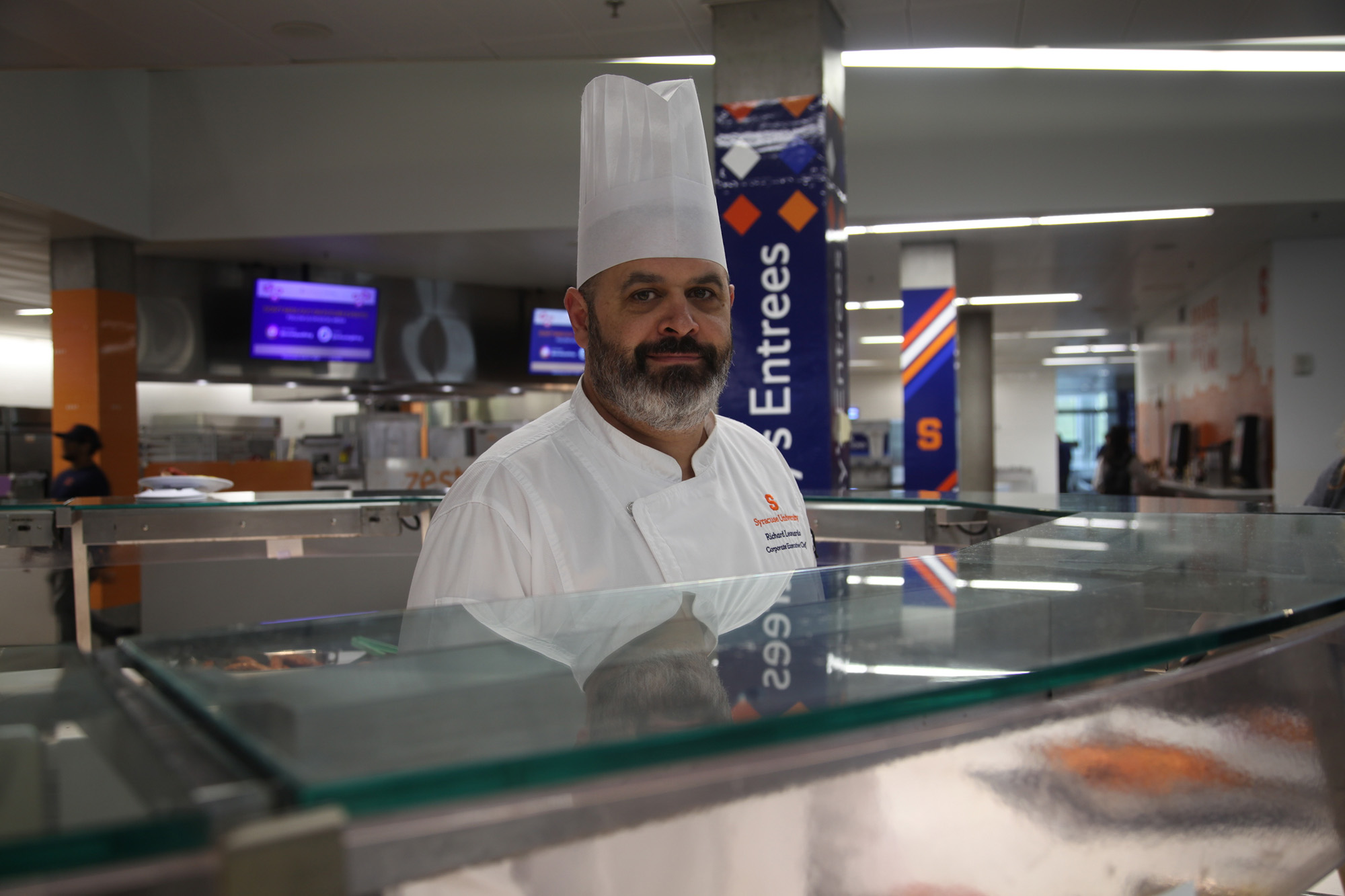
The most challenging part of Richard Leonardo’s job is to cater meals to 8,000 students. Leonardo holds focus groups to ensure all food groups are served. Claire Zhang | Asst. Digital Editor
“There are students who are here two or three times a day, this is their home.” Corey Jordan, chef manager at SU’s Orange Dining Center, said. “If I can give them a healthy, comforting meal and then they’re off to do bigger and better things, that’s a win.”
Though Orange Dining Center is the smallest of all six dining centers, Jordan said he and his team serve nearly 1,300 people per day.
SU’s dining halls cycle menus every four weeks until the end of the semester. Leonardo said they balance a menu with staple dishes like mac and cheese and pizza, while also including dishes that encompass dietary needs and diverse cultures.
Leonardo said this variety is one of the most difficult parts of his job, so he focuses on dietary types like kosher, halal, vegetarian, vegan and gluten-free students to express their needs.
Working with a nutritionist, Leonardo curates the semester’s menu months in advance. Another difficult part is ensuring meals taste the same way they did the last time a student had it at an SU dining hall. With over 200 dining employees across the university, that consistency requires collaboration with other teams.
With more than 20 places to eat, Leonardo said there are a lot of moving parts to produce the necessary breadth of food for SU. That includes coordinating with vendors, visiting the dining centers, collaborating with catering and planning upcoming menus.
Jordan is one of the many SU chefs that work with student-athletes to eat three healthy meals a day. Like Jordan, Jeffrey Dover ensures student-athletes are supplied with sufficient meals throughout the day.
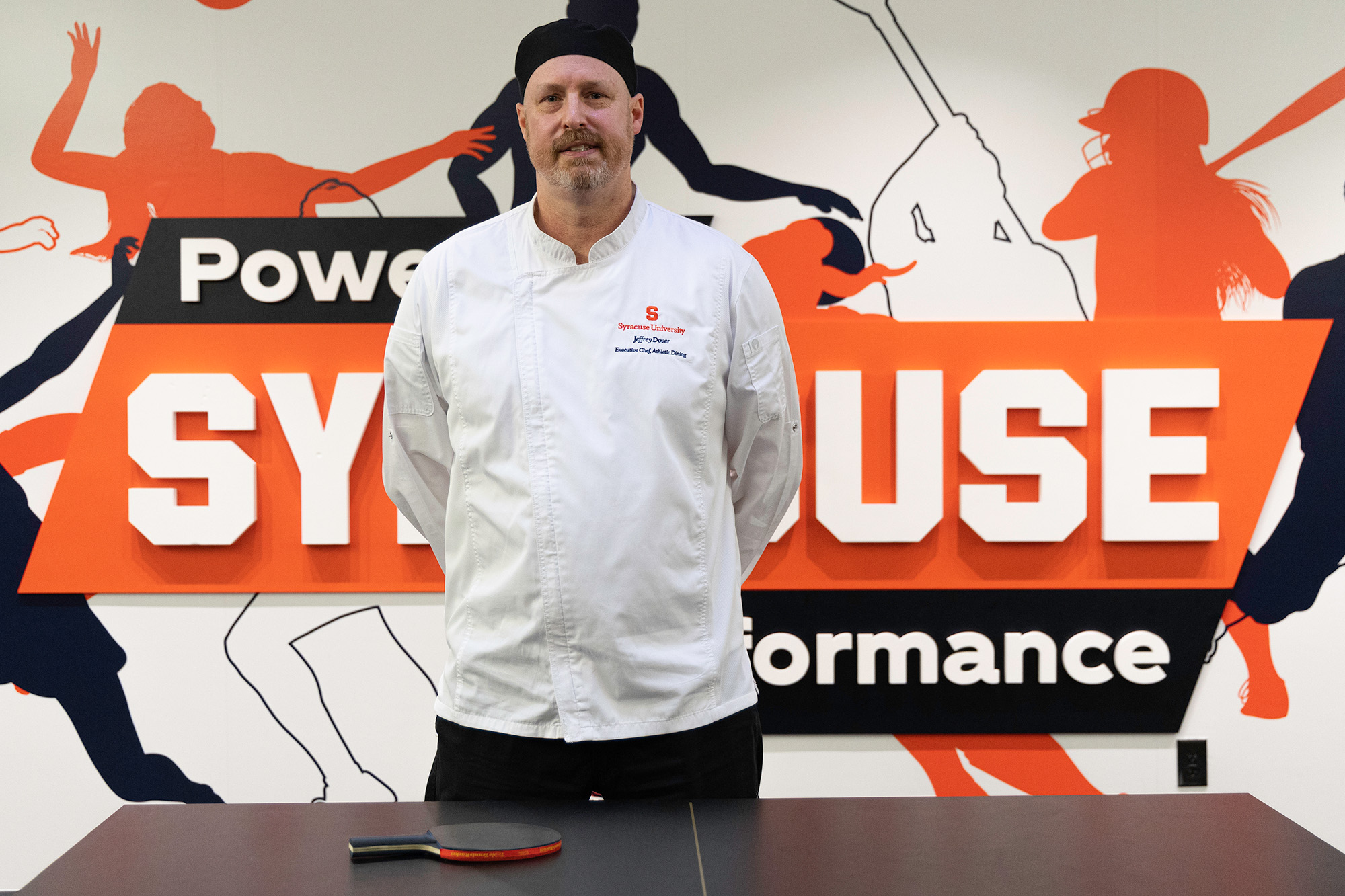
As a former student athlete, Jeffrey Dover understands the importance of having a balanced meal for student athletes. But, in the off-season, Dover has the chance to put a creative spin on his menu. Solange Jain | Senior Staff Photographer,
Dover began working at SU in July 2023 as the director of athletic dining. As a former track and field and cross country student athlete at Penn State University, Dover said he understands the importance of sustaining proper nutrition.
For student athletes, Dover said he’s providing the bulk and stable calories that everyone needs because everyone needs nourishment.
“But if you’re burning, you know, seven or 8,000 calories a day, your needs are going to be different than someone who’s burning 3,000 calories a day,” Dover said.
Since launching Magee One Team Dining in the John A. Lally Athletics Complex last April, Dover can serve food to more athletic teams. From Monday to Thursday, the Magee One Team Dining room is open to athletes and staff of any intercollegiate team at SU for breakfast. Teams can also reserve that space for a pregame meal or postgame dinner.
Since July, Magee One Team Dining, Fallon Family Dining Center (which is exclusively for SU football) and the dining area in the Carmelo K. Anthony Basketball Center (where the basketball teams eat) recorded over 1,000 room bookings for team dining across 14 sports, Dover said.
Before teams dine together, Dover collaborates with nutritionists to curate menus that meet athletes’ nutritional and performance needs, he said. When the teams are on their off-season, Dover said he customizes the meals to themes. For example, the day after SU football’s spring game, Dover worked with SU head coach Fran Brown on a carnival-themed menu — funnel cakes and Jersey tomato pies were on the menu.
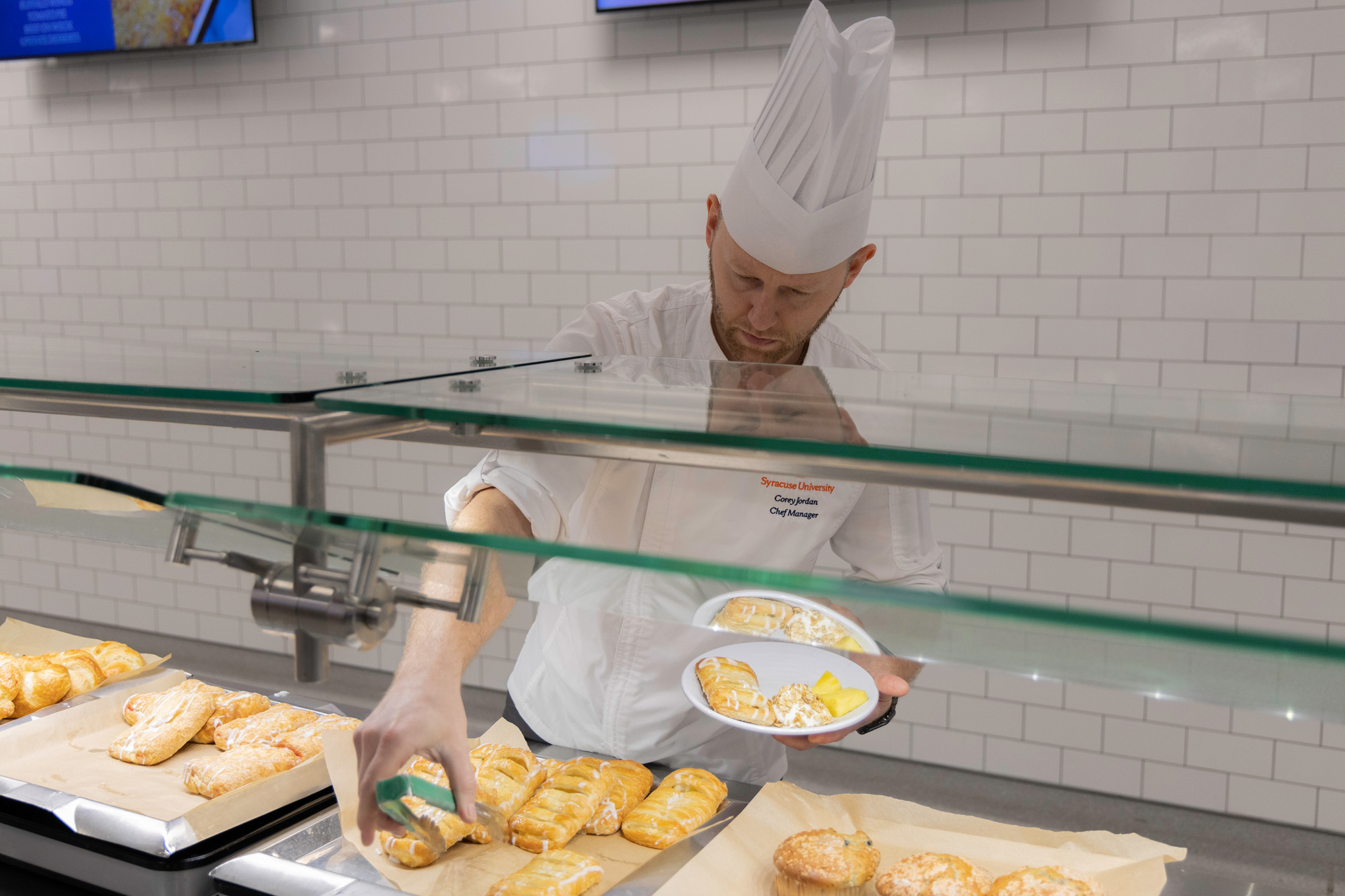
Corey Jordan, chef manager at SU’s Orange Dining Center, serves about 1,300 people every day. Solange Jain | Senior Staff Photographer,
Dover said he’s become friendly with some athletes, to the point where they request meals. Before approving offensive lineman Byron Washington’s request for chicken-fried steak, which Dover had never served before, Dover said he had to ensure that Washington met his performance goals.
But the meals Dover prepares aren’t just for leisure. He also organizes NCAA-mandated training table meals for the sports teams, changing portion sizes based on the NCAA criteria.
“It’s really hard to know from an outsider’s perspective how specific those nutritional needs translate to performance on the field of play,” Dover said. “You really can’t have a lot of guesswork in what you’re providing for the teams. It has to be scientific in nature.”
Athletic dining centers aren’t the only places where dishes are customized at SU. Jordan and his Orange Dining Center team of nearly 60 people have hosted five food “pop-ups” this semester, including upstate New York classic, Mediterranean mezze and Mardi Gras.
“Some of the students have come up to me and the team and said things like, ‘That meal was fire.’ And I’m like, ‘yes, fire is good. I know that,’” Jordan said.
Though menus are usually planned three months in advance, Leonardo said recipe testing is continuous, determining what ingredients might need to change.
That collaboration extends across the dining centers to Orange Hall. Jordan doesn’t want his team in distress when they’re producing food. He said creativity stems from a comfortable environment, whether that be in the kitchen or restocking dishes in front.
Once the kitchen is safe and clean, Jordan feels like it’s time to relax and produce the food.
“I like to say I’m up here in the land of the living because there’s this interaction with people and students,” Jordan said.