Local farmers keep NYS fed with farmers markets, consumer-led agriculture
Get the latest Syracuse news delivered right to your inbox.
Subscribe to our newsletter here.
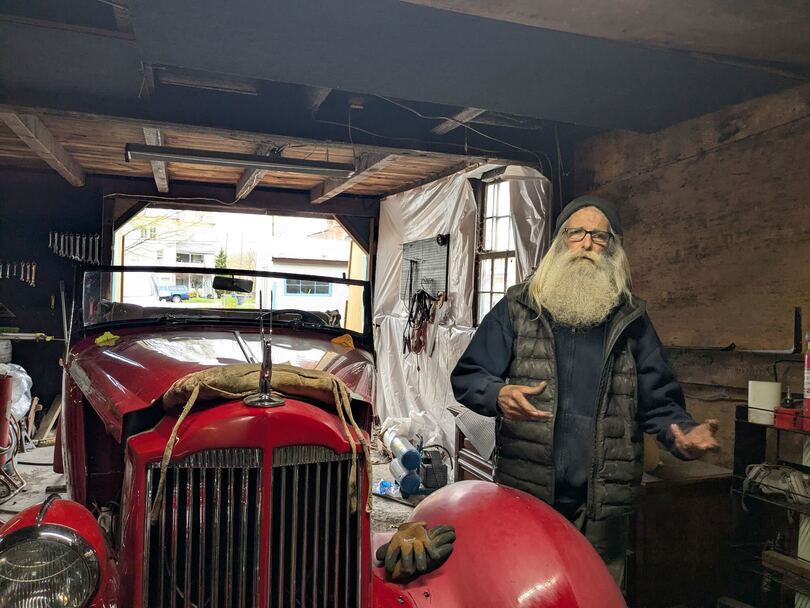
Wayne Adams has agriculture in his blood. He ran away from his family’s six-generation Ithaca dairy farm at 17 and headed west. He grew vegetables in the high deserts of New Mexico before moving to the fertile fields of northern Illinois. Now, at 76, he’s returned to his roots — literally — in Candor, New York, resuming his farming career.
“New York state farmers are some tough motherf—kers,” Adams said.
Adams said he initially had trouble getting back on track due to environmental concerns and the high cost of starting a farm. Now, he lives in a trailer and farms a small plot behind his workshop. To pay his rent, Adams details cars and builds bicycles, saving up to buy new equipment and improve his lot.
Farmers like Adams face a series of agricultural speed bumps in the central New York area. New York’s hilly topography and stony soil make it difficult for farmers to use industrial-sized combine harvesters and tractors efficiently. The region’s harsh winters and short growing seasons also reduce crop yield, leaving small profit margins for farmers.
These conditions make the region better suited for smaller farms growing seasonal crops for local markets, rather than large-scale operations. Growers often do more work by hand and focus on specialized crops like beets and cucumbers. They help ensure that the region’s residents have access to fresh, nutritious in-season produce, according to the Sustainable Agriculture Research and Education program.
A key to local farmers’ success, despite large-scale agriculture being more prominent, is the Community-Supported Agriculture model. Farm customers sign a contract that guarantees them a portion of what farmers produce. Instead of relying solely on farmstand and market revenue like farmers did before the CSA model was adopted, farmers who operate CSA programs can count on steady income from contracts throughout the planting and growing seasons.
While produce selections are usually limited by season, customers can try new varieties of old standards, or even discover obscure vegetables like rutabagas. The farm share model also encourages consumers to build relationships with the farmers they’re buying from, granting them a level of control over what they eat, Tom Ruggieri, co-owner of Fair Share Farm, said.
“It’s not capitalist, because the boss doesn’t own everything, and it’s not socialist, because the government doesn’t own everything,” Ruggieri said. “The people get to decide how to feed themselves.”
Since 2004, Ruggieri has run Fair Share Farm, a 10-acre operation in Kearney, Missouri. But his experience with regenerative agriculture started on a small farm east of Rochester. He wasn’t always a farmer; he earned a master’s degree in civil environmental engineering from Purdue University and spent 20 years as a corporate advisor in the New England area. That’s where he discovered that corporations didn’t share his passion or care for the environment.
“In the corporate world, environmentalism is basically dismissed,” Ruggieri said. “People don’t place value on the diversity of ground that’s in its natural state.”
This experience inspired him to return to the land in 2001. Ruggieri apprenticed at a farm founded by Elizabeth Henderson, who helped create some of the first CSA programs in the country, according to the University of Massachusetts Amherst. She co-wrote “Sharing the Harvest: A Citizen’s Guide to Community Supported Agriculture,” which advocated for a shift toward organically-grown produce, volunteer programs and community buy-in.
At the time, many farmers instead advocated for a heavy dependence on chemical fertilizers and insecticides. But Henderson’s book inspired thousands of CSA programs across the country and created a market estimated at $226 million in 2024.
Fair Share Farm has recently pivoted from the CSA business model, though, and toward growing and preserving vegetables commercially. In an on-site kitchen, workers pickle and jar produce before selling it to local stores. Its CSA-based farm beginnings still demonstrate the national influence of Henderson and central New York’s agricultural history.
During the summer and fall, farmer’s markets can be found in nearly every neighborhood of the city. Their seasonal nature and convenient locations make them suited to support Syracuse’s many underserved communities.
When the Westcott Community Center started the Eastside Farmer’s Market in the late 2000s, the surrounding neighborhood had little access to fresh fruits and vegetables. Even though it’s more connected now, Westcott Community Center’s executive director, Joan Royle, said grocery stores don’t always have the best produce.
“Price Rite has really reasonably priced food,” Royle said. “Would I say that they have a lot of really great quality fresh food? I’m not so sure.”
From June to November, the market hosts between five and seven vendors per week, all based in central New York. Regulars include Brady Farm, which sells seasonal vegetables, and Southwick Family Farm, providing eggs, chicken, pork and beef. Some vendors accept Supplemental Nutrition Assistance Program benefits and state-issued fresh produce coupons, reducing costs for some shoppers. Royle said students and elders are the primary customers. This year, the farmer’s market began holding pop-ups once a month to better serve customers year-round.
“Our regular market vendors are coming for the pop-ups, so it keeps them engaged throughout the winter months,” Royle said. “It keeps the market on people’s minds.”
Royle said the ultimate goal of the farmer’s market was to give local people local access to food.
“We really want to work on the assets that we have, and the skills and the talents and all of the things that people are doing right here in Syracuse,” Royle said.
Beth Southwick owns Southwick Family Farm in Nedrow, New York, eight miles south of Syracuse. She started the farm’s current incarnation in 2023 but had been growing on the land since 2010. Her farm is a regular vendor at farmer’s markets like the one in Westcott but also sells directly to consumers who can drive to the farm store.
Southwick said business at the market decreased during the winter but still accrued more than what she’d get at the farm. In the summer, though, she added that business increased steadily.
Unlike Southwick, Adams hasn’t owned land for a long time. He’s currently farming a small, rented plot and keeping what he grows for himself. Soon, though, he plans to buy a greenhouse and scale up his operation — adding to the well-established food culture in central New York
“It’s all about how you’re thinking,” Adams said. “If you think you can do it, you can.”