AI use, flavorless performances overpower patriotism in ‘Young Washington’
Get the latest Syracuse news delivered right to your inbox.
Subscribe to our newsletter here.
A notorious myth about George Washington is that he wore wooden teeth. In reality, he sported dentures made from various materials like hippopotamus ivory, metals and human teeth. Historians and dentists believe red wine may have darkened his dentures, causing them to resemble wood.
Much like the dentures, Jon Erwin’s “Young Washington” has plenty to chew on, but average performances, lazy writing and questionable creative choices dull its bite.
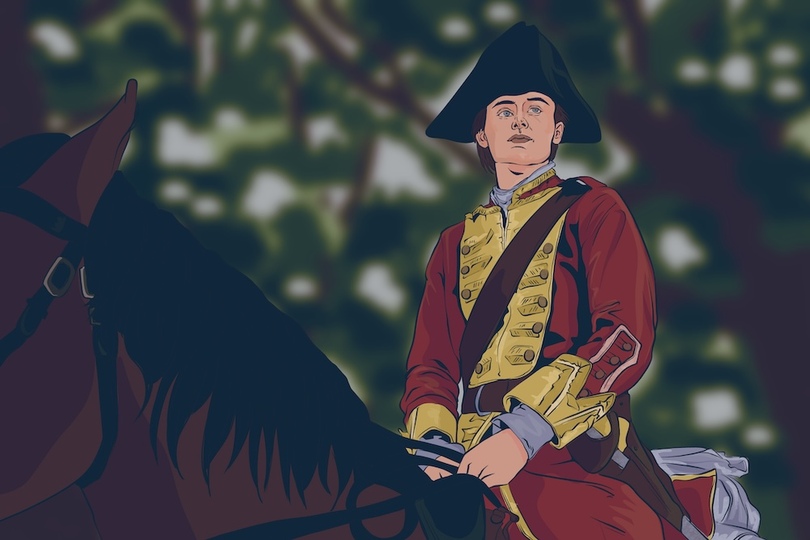
Released July 3 (just in time for the U.S. 250th anniversary), “Young Washington” follows George’s (William Franklyn-Miller) early military career serving the British during the French and Indian War decades before the American Revolution.
One of the first sequences shows George after his father’s death in 1743. Eleven-year-old George is now forced to help his mother at home, which prevents him from receiving a formal education. Mentored by his half-brother, Lawerence Washington (John Foss), George learned land surveying skills.
In the early 1750s, Robert Dinwiddie (Ben Kingsley), the lieutenant governor of Virginia, sent George to survey the Ohio territory and deliver a message to a French military fort demanding they leave the area. Because the French refused, George, his group of Virginia militiamen and Native Americans led by Half-King Tanacharison (Ryan Begay) killed the French, sparking the start of the French and Indian War.
In 1754, at Fort Necessity (present-day Pennsylvania), George and his troops were overpowered by the French and surrendered. A year later, George became General Edward Braddock’s (Andy Serkis), aide-de-camp, or assistant, and fought at the Battle of the Monongahela, solidifying his reputation as a courageous soldier.
Franklyn-Miller portrayed George decades before he’d become the white-haired American hero you learn about in grade school. Still, playing such an important figure — no matter the era — is a daunting task. That’s demonstrated by Franklyn-Miller’s flavorless performance.
He’s not bad by any means, but it often feels like he’s going through the motions — even with Erwin framing George as a somewhat invincible figure at the end of the film. Franklyn-Miller’s passable performance fittingly represents the painfully average cast.
There are a few bright spots, like Mia Rodgers playing Sally Cary — George’s brief love interest — and Kelsey Grammer as Lord Fairfax. But both Rodgers and Grammer barely appear on screen. We first meet them during my favorite sequence, when George sneaks into a gathering held at Fairfax’s plantation.
Sally tells George he sticks out like a sore thumb, and despite sharing romantic feelings, she’s ultimately a footnote in the film. Rodgers’ boldness sharply contrasted Franklyn-Miller’s underwhelming presence.
Among stagnant characters, Fairfax was a refreshing change — though he only appeared early on. At the gathering, George finds the wealthy Fairfax dodging his own party by hiding in his library. Instead of dismissing George, Fairfax and George have a friendly conversation, discussing books and surveying. Grammer, even with minimal screentime, gives the most convincing performance of the cast. Thanks to his gravitas, the scene feels like a rare, genuine moment shared between characters.
An uninspired script filled with gimmicks adds to the mundane characters. When George finds out Lawerence died from an illness, he chops a tree in frustration, lazily paralleling young George after his father died — a possible riff off of George’s classic cherry tree story.
Another mythbuilding crutch in “Young Washington” is a phrase we first hear when Lawerence beats kid George in a game of chess: “Even a pawn can take the king.” The line, a clever metaphor hinting at George and the Continental Army defeating the British monarchy during the American Revolution, is exhausted throughout the film. And there are several “I am Iron Man” moments, where George epically, though comically, reveals his name to people.
The strong suit of “Young Washington” is the recreation of the 18th-century atmosphere. Erwin and his crew filmed on location and brilliantly captured western Pennsylvania‘s wilderness — even though they primarily shot in Ireland and Virginia.
The visuals reminded me of “The Revenant,” using wide landscape shots to capture the environment. But the cinematography is nowhere near that level of mastery. While the visuals are pleasant, “Young Washington” features the overpolished, Netflix-style look.
However, the real red wine stain is the film’s use of artificial intelligence, which Erwin has openly discussed. Erwin told Variety that approximately 100 shots were augmented with AI. Despite my personal animosities, the practice is understandable for a picture with a modest budget. But the precedent is dangerous.
“Movies are like a machine that generates empathy,” film critic Roger Ebert said in “Life Itself.” “It lets you understand a little bit more about different hopes, aspirations, dreams and fears. It helps us to identify with the people who are sharing this journey with us.”
If one day films are substantially made with AI, they’ll ultimately lack human touch and connection.
Still, “Young Washington” is a serviceable flick that’ll fill you with patriotism. Outside of some creative liberties with the timeline, the film is mostly accurate. And I appreciate seeing George’s failures during the French and Indian War — he’s not entirely romanticized. The conflict and subsequent bounceback is formulaic, though.
With a sequel (“1776”) already on the horizon, I hope Erwin drops the AI and tackles a more compelling story with ambitious themes — exploring George’s relationship with British foes that he used to fight alongside could be interesting. But for now, we have a forgettable yet entertaining portrait about the father of our country.